Nobody talks about the Tourist Tax in Croatia 2026 until it shows up on their bill. Then suddenly everyone’s asking: what is it, why is Dubrovnik more expensive than Zagreb, and did my Airbnb host just quietly add an extra charge? Fair questions, all of them.
Croatia’s tourist tax 2026, officially the Boravišna pristojba, is a per-person, per-night fee charged across every type of registered accommodation in the country. Hotels, apartments, campsites, hostels, boats. It funds local beaches, cultural sites, and general tourist infrastructure. The catch: rates aren’t uniform. They change by city, by season, and by accommodation type. What you pay in Hvar in August is not what you’d pay in Zagreb in November. This guide covers all current rates, the exemptions most people never claim, and what’s new heading into 2026.
Rates by City: Croatia Tourist Tax in 2026
• ) Dubrovnik
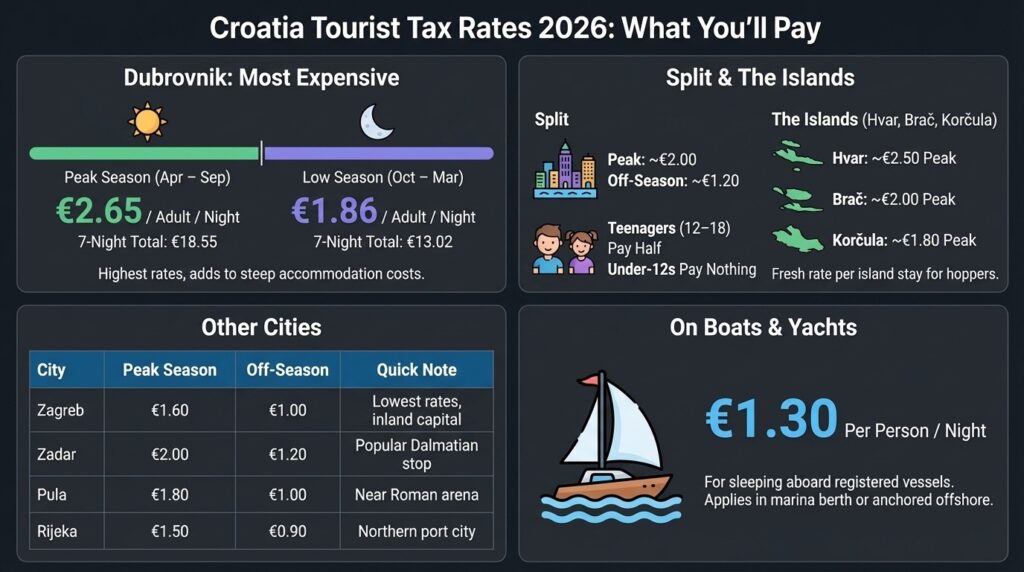
The most expensive city in Croatia for almost everything, including this. Current confirmed rates sit at €2.65 per adult per night from April through September. Outside that window, it drops to €1.86. A week in peak season costs you €18.55 in tax per person. Not dramatic on its own, but Dubrovnik’s accommodation prices are already steep this just adds to the pile.
| Season | Rate / Adult / Night | 7-Night Total |
| Peak (Apr – Sep) | €2.65 | €18.55 |
| Low (Oct – Mar) | €1.86 | €13.02 |
• ) Split
A bit more reasonable. Peak season runs around €2.00, off-season closer to €1.20. Split is also where families tend to notice the child discount; most teenagers (12–18) only pay half, and under-12s pay nothing. Worth factoring in if you’re travelling with kids.
• ) The Islands Hvar, Brač, and Korčula
Hvar peaks at roughly €2.50 per night. Brač is around €2.00, Korčula about €1.80. The tax applies per island stay; if you’re island-hopping, you’re paying a fresh rate at each stop. Budget accordingly.
Other Cities
| City | Peak Season | Off-Season | Quick Note |
| Zagreb | €1.60 | €1.00 | Lowest rates in Croatia |
| City | Peak Season | Off-Season | Quick Note |
| Zadar | €2.00 | €1.20 | Popular Dalmatian stop |
| Pula | €1.80 | €1.00 | Near the Roman arena |
| Rijeka | €1.50 | €0.90 | Northern port city |
Zagreb is the outlier. It’s an inland capital with no coastline to maintain; the rates reflect that. If you’re mixing Zagreb with a coastal leg, the capital stretch will barely register.
• ) On Boats and Yachts
Often missed: anyone sleeping aboard a registered vessel in Croatian waters pays €1.30 per person per night. Marina berth or anchored offshore, same rate either way. Sailboat enthusiasts often find this out at checkout.
Exemptions Most People Never Ask
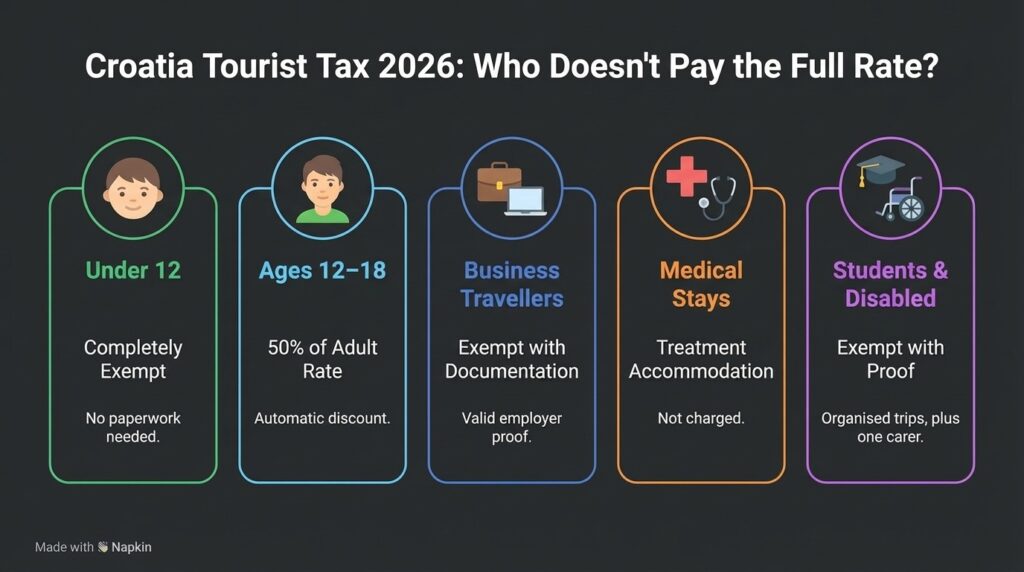
There’s adecent list of people who don’t pay the full tourist tax in Croatia in 2026. Most accommodation hosts won’t volunteer this information unprompted.
- Under 12 is completely exempt, no paperwork needed.
- From Ages 12–18, 50% of the adult rate.
- Business travellers are exempt with valid employer documentation.
- Medical stays, treatment accommodation isn’t charged.
- Students on organised trips and people with significant disabilities (plus one carer) can also qualify. You’ll need to show proof.
What’s Changing in 2025 – 2026?
The seasonal rate structure has been confirmed to continue as-is. But a couple of things are worth watching. Dubrovnik’s city council is seriously discussing another rate increase, as the Old Town is UNESCO-listed, and visitor numbers are straining it. No confirmed hike yet, but it wouldn’t be surprising before summer. Several Dalmatian islands are also weighing separate eco-fees on top of the Sojourn Tax. Again, nothing legislated as of early 2026, but it’s in active discussion.
Short-term rental enforcement has tightened noticeably, particularly in Dubrovnik. If your Airbnb host asks for the tax in cash on arrival, that’s standard practice, not a scam.
Three Things to Sort Before You Arrive
1 ) Check whether the tourist tax is already in your booking total. Some platforms include it; others list it separately or not at all. Look at the itemised breakdown before confirming.
2 ) Carry small euro notes or coins. Private rentals rarely take a card for this fee. A few small bills save an awkward conversation.
3 ) May, early June, and September are the sweet spots. The weather is nearly identical to July, room prices drop significantly, and the tax rate flips to the lower band.
Most Frequently Asked Questions
Q.) What is the Tourist Tax in Croatia?
A mandatory nightly fee is charged to everyone staying in registered accommodation. The money goes toward tourism infrastructure, beaches, and cultural preservation.
Q.) What is the tourist tax in Dubrovnik in 2026?
It Is €2.65 per adult per night from April to September. €1.86 per night from October to March.
Q.) Do the children have to pay the Tourist tax in Croatia?
Under-12s are fully exempt. And the children who are between 12 to 18 have to pay half of the adult rate.
Q.) Is the tax rate the same in Croatia?
No, each municipality sets its own rate. Dubrovnik and Hvar charge the most. Zagreb and inland towns charge the least.
Q.) Is it already included in hotel prices?
Not always. Check the itemised total carefully. Booking platforms handle it differently, and some private hosts collect it separately at check-in.
Conclusion:
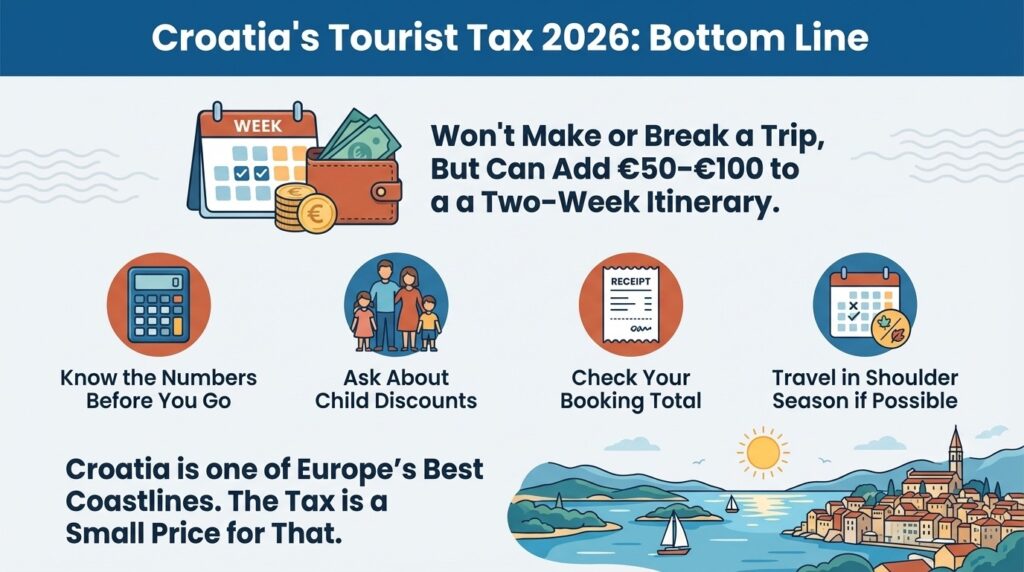
Croatia’s Tourist Tax won’t make or break a trip. But it can quietly add €50–€100 to a two-week itinerary if you’re not watching. Knowing the numbers before you go and remembering to ask about child discounts, check your booking total, and travel in the shoulder season if possible is all it really takes. Croatia is one of the best coastlines in Europe. The tax is a small price for that.