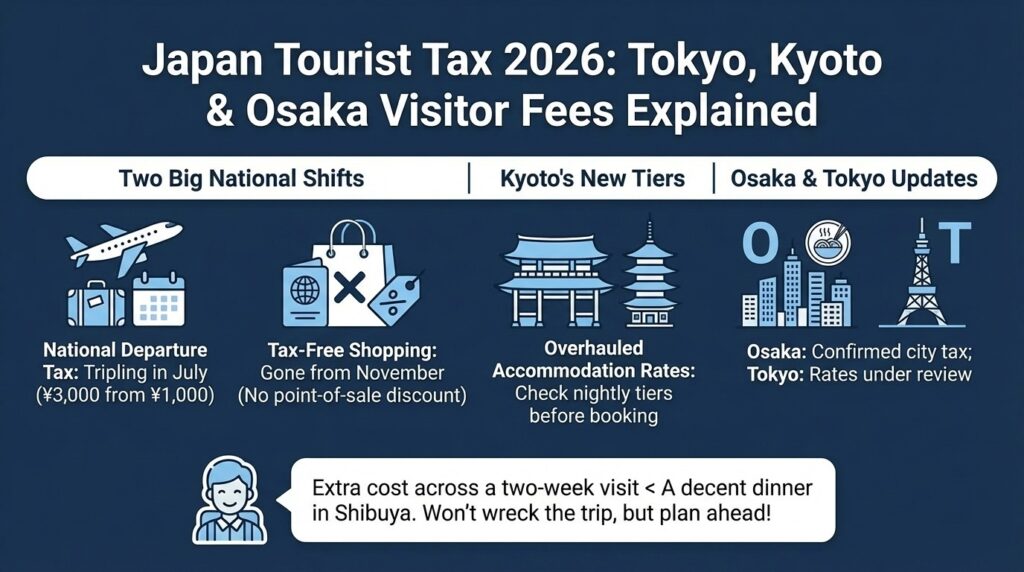
Let’s get one thing out of the way: none of these taxes is going to wreck your trip. Japan is still an incredible value compared to most of Western Europe, and even with the changes rolling out this year, the extra cost across a two-week visit works out to less than a decent dinner in Shibuya. But you do need to know what’s changed, because a few of the 2026 updates are genuinely significant, and walking into Kyoto without checking the new nightly rates first is the kind of thing you’ll only do once.
Two big shifts define 2026. The national departure tax is tripling in July. And Japan’s beloved tax-free shopping system, the one where you flash your passport and pay ten percent less on the spot, is gone from November. Add in Kyoto’s completely overhauled accommodation tiers, and there’s a fair bit to unpack before you book anything.
What Is the Japan Tourist Tax, Exactly?
Most people use “tourist tax” as a catch-all, but in Japan, it actually covers two separate things. There’s the departure levy, a flat national fee charged every time you leave the country by air or sea. And then there’s the local accommodation tax, which varies city by city and gets added to your hotel bill each night. You’ll almost certainly pay both on a standard trip. They’re collected differently, spent differently, and calculated differently. Worth understanding each on its own terms.
The Departure Tax Is Tripling from July 1
Japan introduced its departure levy of 1000 yen in 2019 for each person, which is about $7. But from July 1, 2026, it jumps 3000, and this jump isn’t a single jump; it’s a full wave, which means a family of four now has to pay 12,000 yen
You don’t have to do anything special; airlines build it into the ticket price automatically, and it shows up under government taxes on your booking receipt. But if you’re shopping fares right now, check your departure date carefully. Book a flight home before July 1, and you’re on the old 1,000 yen rate. After July 1, you’re on 3,000 yen. For solo travellers, that’s about thirteen dollars extra. For groups, it adds up faster than you’d expect.
Exemptions: Children under two fly free of this charge. So do transit passengers who arrive and depart within 24 hours without clearing customs. Everyone else – tourists, expats, business travellers, Japanese nationals – pays in full.
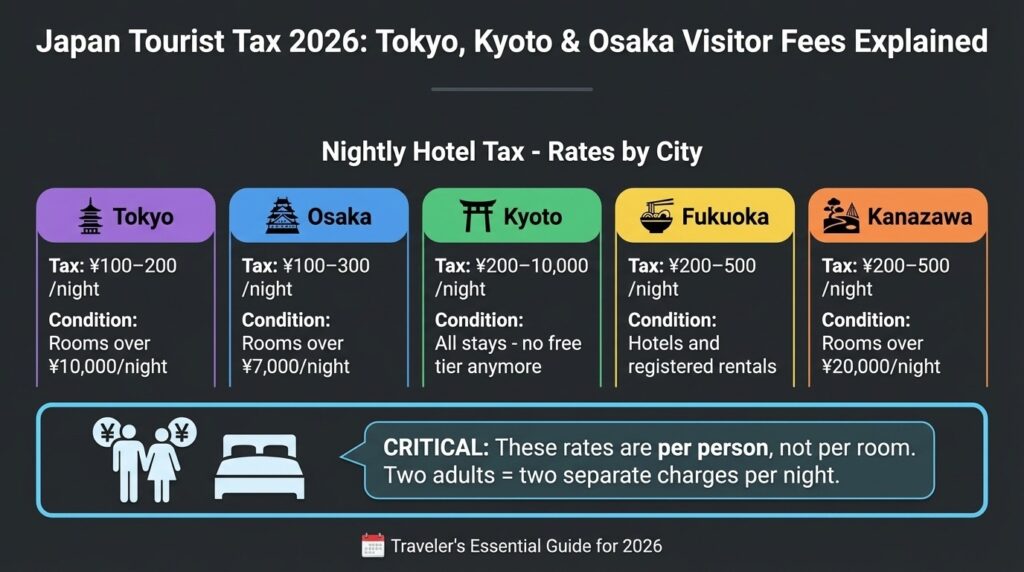
Nightly Hotel Tax – Rates by City
Local accommodation taxes are where things get city-specific.
While Tokyo kept his Rateslow hold the budget travelers in its city, due to this, Tokyo went into a very different direction as of March 2026. Here is the current picture across the main destinations:
Tokyo 100–200 yen Rooms over 10,000 yen/night Osaka 100–300 yen Rooms over 7,000 yen/night Kyoto 200–10,000 yen All stays – no free tier anymore Fukuoka 200–500 yen Hotels and registered rentals Kanazawa 200–500 yen Rooms over 20,000 yen/night
One thing that catches people off guard: these rates are per person, not per room. Two adults in the same Osaka hotel room both pay the nightly charge. Over ten days, that’s twenty separate charges, not ten.
Kyoto’s New Tax Tiers | This One Matters
Kyoto quietly did something pretty bold in March 2026. The city scrapped its old accommodation tax structure and replaced it with a tiered system where luxury stays now attract 10,000 yen per person per night at the top end. The old maximum was 1,000 yen. So if you and a partner are splurging on five nights at a high-end Higashiyama ryokan, you’re looking at 100,000 yen in accommodation tax separate from the room rate entirely.
Cheaper stays aren’t exempt either. The budget tier that used to charge nothing is gone; even hostel guests pay a small nightly amount now. The city’s reasoning isn’t really subtle. Kyoto is genuinely struggling under the weight of its own popularity, and this is one of the tools it’s using to manage that. Whether you agree with the approach or not, the rates are what they are, and they need to be in your numbers before you book.
Tax-Free Shopping Changes in November
From November 1, 2026: Japan’s instant in-store tax exemption ends. You’ll pay full price at the register and claim your 10% refund at airport customs before boarding. Build in extra time at the airport if you’re a serious shopper.
For years, tourists in Japan could show a passport at department stores, electronics shops, and drugstores and receive an immediate ten percent discount at checkout. That system ends on November 1, 2026. The replacement works more like the UK or Australian model, where you pay the full price in-store, hold onto every receipt, and then present your purchases at an airport customs counter before your flight to get the consumption tax refunded.
Refunds are paid by card, e-payment, or cash. The minimum spend stays at 5,000 yen.
If you’re travelling before November, nothing changes for you. If you’re arriving after, plan for a customs queue before departure, and don’t let the receipts get buried in your bag.
How Do You Actually Pay?
The departure levy is invisibly built into your ticket; there’s nothing to do on your end. The nightly accommodation tax is either collected at online checkout (check the itemised total on your booking confirmation) or added to your hotel bill when you leave. Most big city hotels and international booking platforms handle it upfront now. Smaller traditional ryokans sometimes prefer cash for this specific charge even when they take cards for everything else, so keeping a few hundred yen in notes handy is genuinely useful.
Quick Answers
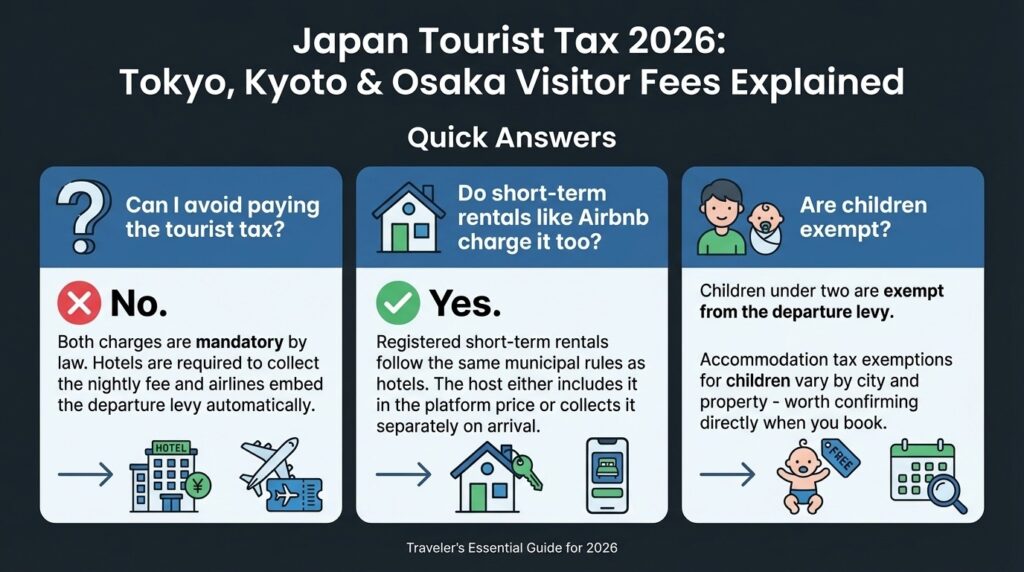
Q. Can I avoid paying the tourist tax?
No. Both charges are mandatory by law. Hotels are required to collect the nightly fee, and airlines embed the departure levy automatically.
Q. Do short-term rentals like Airbnb charge it too?
Yes – registered short-term rentals follow the same municipal rules as hotels. The host either includes it in the platform price or collects it separately on arrival.
Q. Are children exempt?
Children under two are exempt from the departure levy. Accommodation tax exemptions for children vary by city and property – worth confirming directly when you book.
Q. Will these rates go up again?
Possibly. Several municipalities are reviewing their structures, and the shift in shopping tax collection suggests the government is in an active phase of tourism revenue reform. Any confirmed changes tend to be announced months in advance.