
Introduction
Planning a trip to Denmark this year? and curious whether a tourist tax will quietly inflate your hotel bill? And this is a very common question because a lot has changed since 2025. A very short answer is that there is no national tourism levy as of 2026, but now the campaign is close to making this law, and the surcharges of the hotels are spreading faster than most booking platforms show. Here is everything that actually matters before you book.
Does Denmark have any tourist tax for 2026?
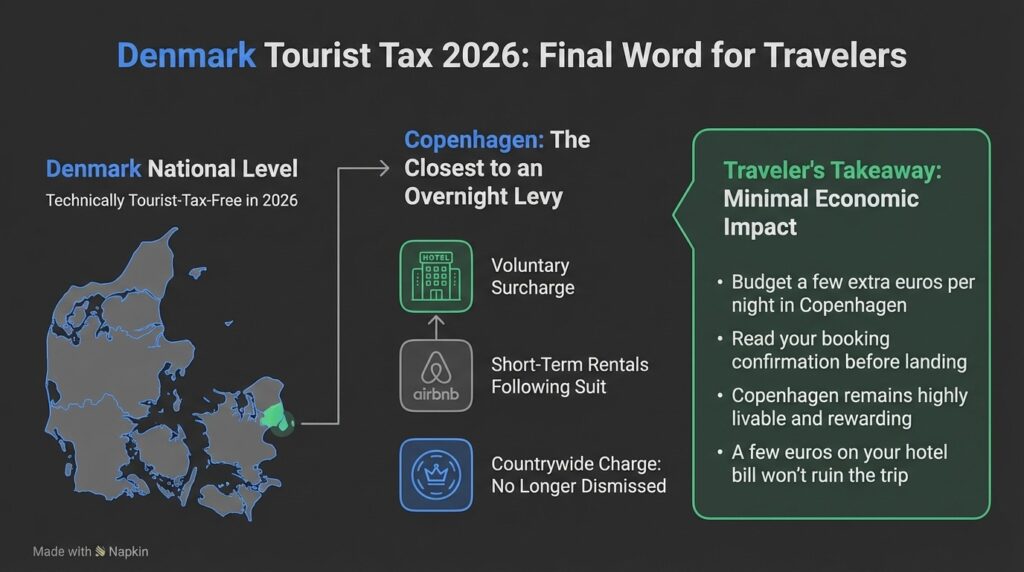
But this thing is technically NO because if there is no Law it doesn’t mean this thing is not real. Denmark remains without a government-mandated visitor charge at the national level. What exists instead is a growing patchwork of voluntary hotel surcharges concentrated in Copenhagen, plus a city-level overnight levy that is now formally in front of Denmark’s Business Ministry, awaiting a green light.
Most travelers outside the capital will still check out without a single extra line on their invoice. Inside Copenhagen, though, that €2–€4 per night ‘green surcharge’ or ‘environmental contribution’ is showing up on more properties than ever before, and the figure is quietly creeping upward at premium hotels. One practical role that you should always keep in mind is that if you stay in central Copenhagen, then you have to pay a small nightly add-on, and also always verify your booking confirmation before you arrive.
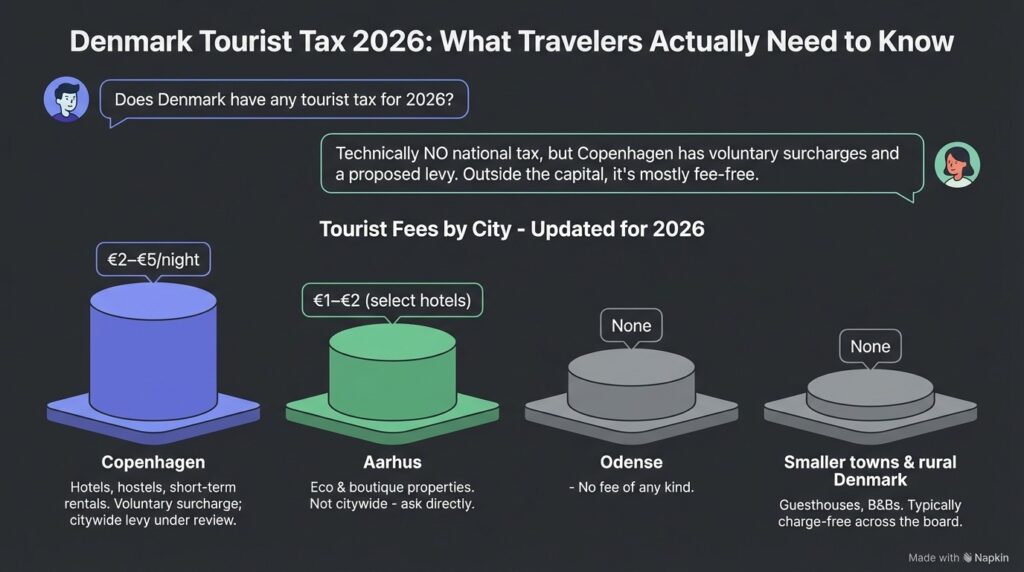
Tourist Fees by City – Updated for 2026
| City / Region | Fee (2026) | Who It Applies To | Notes |
| Copenhagen | €2–€5/night | Hotels, hostels, short-term rentals | Voluntary surcharge; citywide levy under final ministerial review |
| Aarhus | €1–€2 (selected hotels) | Eco & boutique properties | Not citywide – ask your property directly |
| Odense | None | – | No fee of any kind |
| Smaller towns & rural Denmark | None | Guesthouses, B&Bs | Typically charge-free across the board |
| ■ Tip: These fees are almost always baked into the advertised nightly rate. Read the full itemised breakdown in your booking confirmation, not just the headline total. A line labelled ‘sustainability fee’ or ‘climate contribution’ is your tell. |
How and Where Is the Money Collected?
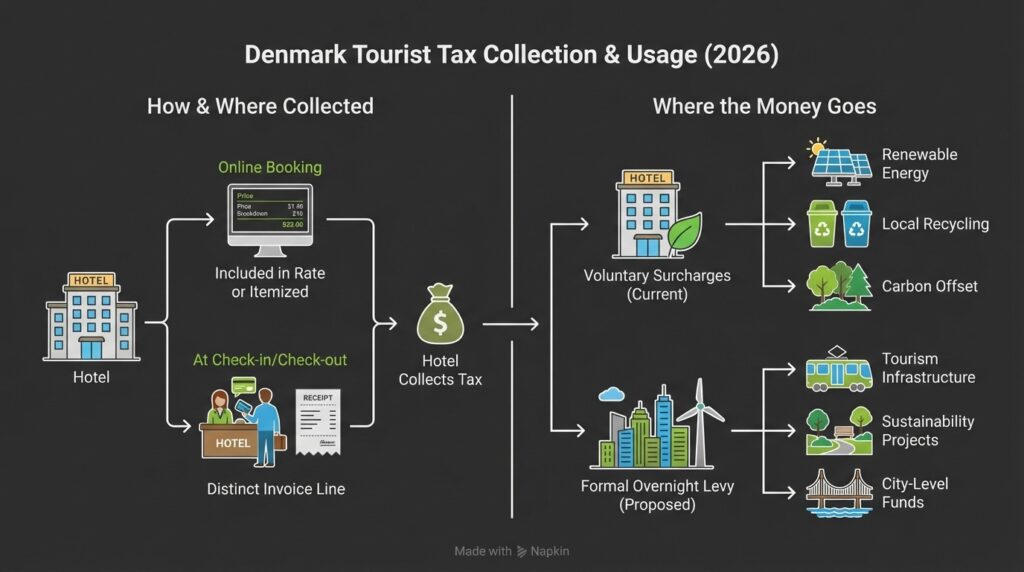
Hotels handle collection entirely on their own, either folding the amount into the rate you paid online or itemising it separately at check-in or check-out. If it appears as a distinct line on your invoice, it is a contractual part of your booking, not a surprise admin charge you can dispute.
Where does that money go? For the voluntary surcharges, it stays with the property. Most Copenhagen hotels participating in the city’s green certification programmes direct the funds toward on-site renewable energy installations, local recycling schemes, or carbon offset partnerships, not a central government fund. If Copenhagen approves a formal overnight levy, the city will ring-fence the revenue for tourism infrastructure and sustainability projects, similar to how Amsterdam and Barcelona manage their visitor taxes.
The Copenhagen Situation | Where Things Stand Right Now
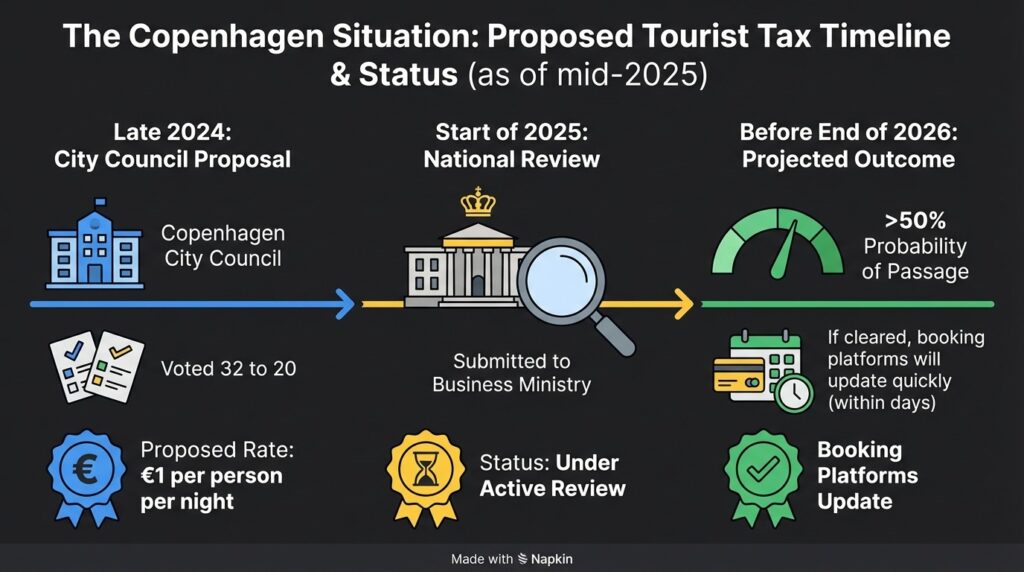
This is the part that could affect your trip most directly, especially if you are booking months ahead. Copenhagen’s city council voted 32 to 20 in late 2025 to formally propose an overnight visitor levy – the model on the table sets the charge at €1 per person per night. That proposal was received by Denmark’s business ministry at the start of 2024 and is still under active review
In the past, the national government rejected similar proposals, citing concerns about Denmark’s competitiveness as a travel destination compared with other Scandinavian markets. However, political dynamics have now shifted. With Copenhagen’s council now formally and unanimously pushing for the change, the ministry is under more pressure than at any previous point. Travel industry analysts tracking the file put the probability of passage before the end of 2026 at higher than fifty percent. If it clears, booking platforms will update their price displays quickly – within days, based on how similar laws rolled out in the Netherlands and Portugal.
Key Developments to Track in 2026
| Copenhagen Airbnb hosts are increasingly passing fees to guests | What It Means for You |
|---|---|
| Copenhagen city levy before the Business Ministry | €1/person/night could become mandatory mid-2026 |
| No confirmed approval timeline | Could pass quickly – build it into long-stay budgets now |
| Hotel surcharges are climbing to €5/night at premium properties | Budget up from the old €2–€4 estimate for 4- and 5-star hotels |
| Nationwide eco-levy under parliamentary discussion | Country-wide charge not imminent but no longer theoretical |
| Short-term rental platforms (Airbnb, Vrbo) are integrating surcharge collection | Copenhagen Airbnb hosts are increasingly passing fees to guests |
Practical Tips Before You Travel to Denmark in 2026
• €2–€5 per night Budget for hotel surcharges if staying in central Copenhagen or at an eco-certified property in Aarhus.
• Booking outside Copenhagen? You will almost certainly avoid any additional charge in rural Denmark, and most smaller cities remain fee-free.
• Read your booking confirmation carefully, look for any line item labelled ‘environmental fee’, ‘green surcharge’, or ‘sustainability contribution’.
• Staying through a short-term rental platform in Copenhagen? Check the listing notes by the host; Airbnb and Vrbo hosts are increasingly adding this charge to their nightly stay rates.
• If Copenhagen’s formal levy passes during 2026, it will roll out on booking platforms quickly. Keep an eye on your email if you have reservations already confirmed.
• Travelling with children? Current hotel surcharge policies across Denmark exclude minors – fees apply per room or per adult only.
Frequently Asked Questions
Q1. Is there any tourist tax/levy in Copenhagen in 2026?
Not yet officially. Hotels may add €2–€5 per night as a voluntary surcharge. Authorities have proposed a €1 per person, per night citywide tax, which the government is reviewing. As of early 2026, it has not yet become law.
Q2. Does Denmark have a tourist tax in 2026?
In short NO, A countrywide Tourist tax levy has been discussed multiple times in the Parliament, but no national charge has been passed
Q3. Are children charged the tourist tax or hotel surcharge?
No. All current voluntary surcharges in Denmark apply per room or per adult. Children are not included, and even the proposal ( To the government) also excludes children in the same way.
Q4. What is the exact green surcharge on a Danish hotel bill?
This is voluntary; it is typically around €2 to €5. Add participating properties only, and these funds go to the ECO, like renewable energy systems.
Q5. Could a formal tourist tax launch in Denmark before the end of 2026?
Yes, realistically. Copenhagen’s proposal is sitting with the Business Ministry and carries stronger political backing than any previous attempt. Most travel analysts put the odds of passage within 2026 above fifty percent. If you are booking a long stay in Copenhagen, it is worth building the €1 per person per night into your budget as a contingency.
Final Word
Denmark in 2026 is still technically tourist-tax-free at the national level – but that headline is doing less work than it used to. Copenhagen is the closest it has ever been to locking in an official overnight levy, hotels across the capital are raising their voluntary surcharges, short-term rentals are following suit, and a countrywide charge is no longer being dismissed outright in parliament.
For most visitors, none of this will dramatically change the economics of a Denmark trip. Budget a few extra euros per night in the capital, read your booking confirmation before you land, and you will not be caught off guard. Copenhagen remains one of the most livable, walkable, and genuinely rewarding cities in northern Europe. A few euros on your hotel bill is about the last thing that should put you off going.