
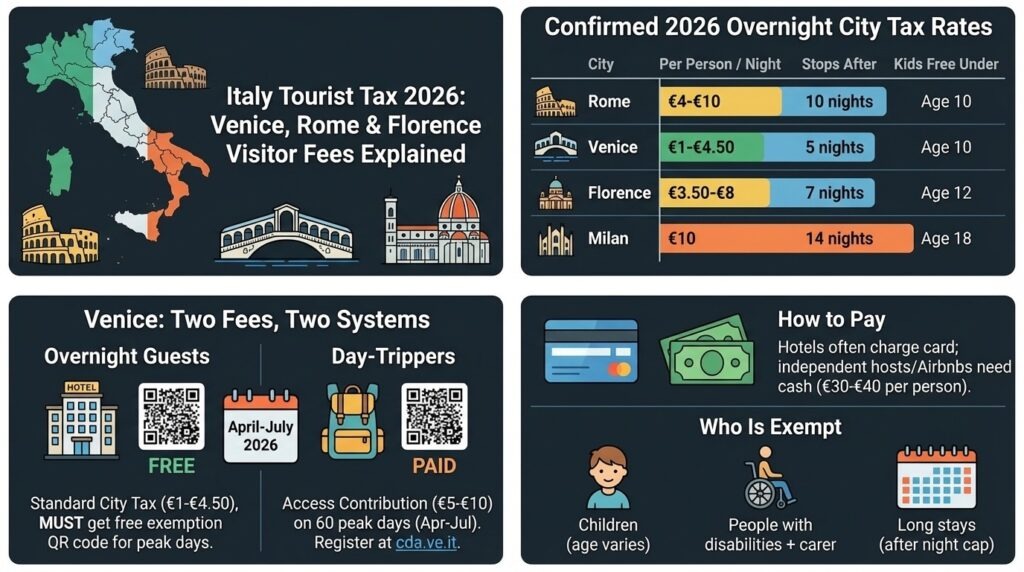
Nobody tells you about it when you book. It’s not in the headline price on Booking.com or Airbnb. You find out at check-in, sometimes check-out, when a handwritten figure appears on your invoice and your host says, cheerfully, It’s the “City Tax” That’s the Italy tourist tax 2026, officially called the imposta di soggiorno, and every city sets its own rate. Rome’s is different from Florence’s. Venice runs two completely separate systems at once. Milan jumped its rate this year specifically because of the Winter Olympics. It’s a lot – so here’s the short version.
Confirmed 2026 overnight city tax rates across Italy.
| City | Per Person / Night | Stops After | Kids Free Under |
| Rome | €4.00 – €10.00 | 10 nights | Age 10 |
| Venice | €1.00 – €4.50 | 5 nights | Age 10 |
| Florence | €3.50 – €8.00 | 7 nights | Age 12 |
| Milan | €10.00 | 14 nights | Age 18 |
| Turin | €4.50 (from Apr 1) | 7 nights | Age 12 |
| Trieste | €3.30 (from Jan 1) | 5 nights | Age 18 |
Tourist tax in Rome
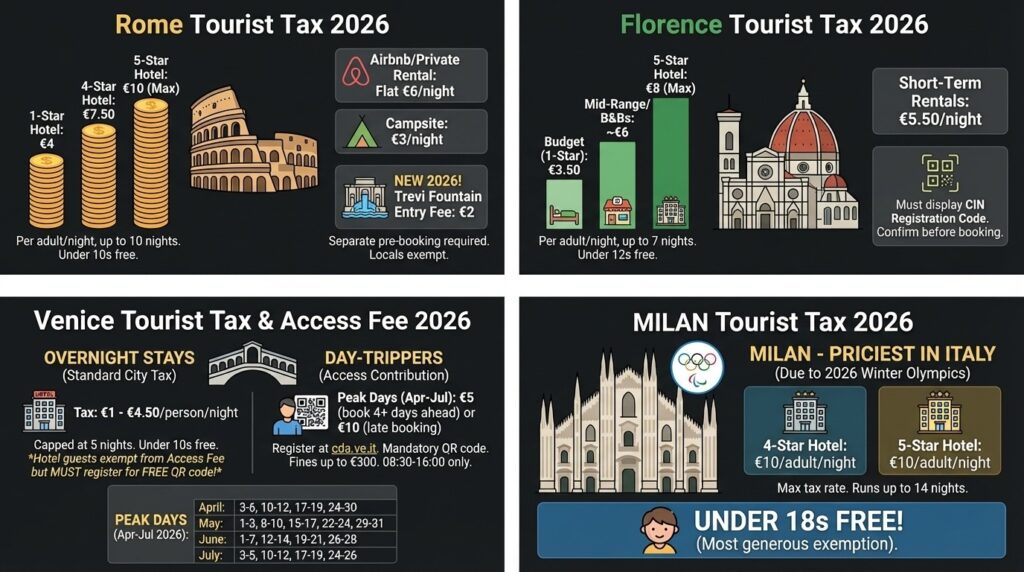
Star rating drives everything here. One-star: €4. Four-star: €7.50. Five-star hits the ceiling at €10 per adult per night. Airbnbs and private rentals pay a flat €6 doesn’t matter how nice the apartment is. Campsites: €3. The charge stops at ten nights. Under-tens are free.
In 2026, a new thing was introduced: a €2 entry fee at the Trevi Fountain. This is separate from the tourist tax and requires pre-booking; locals are exempt. Worth knowing if it’s on the itinerary.
Tourist tax in Florence
Same star-rating logic as Rome, slightly different numbers. Budget end is €3.50; five-star cap at €8. Most mid-range hotels and B&Bs, the ones most visitors actually book, sit around €6. Charge stops after seven nights. Under-twelves pay nothing. Short-term rentals are taxed at €5.50 and must display a national CIN registration code on their listing. If yours doesn’t have one, ask before you confirm.
Tourist tax in Venice: Two Fees, Read This Carefully.
Venice runs two completely different visitor charges in 2026, and confusing them is an easy, expensive mistake.
Staying overnight? You pay the standard city tax of €1 to €4.50 per person per night, depending on the property, capped at five nights. Under-tens are free. Normal.
Day-tripping without a hotel booking? On 60 designated peak days between April 3rd and July 26th, 08:30 to 16:00, you only need to pay an access contribution. Register at cda.ve.it at least four days ahead: €5 per person over 14. Leave it later: €10. You get a QR code. Wardens check it.
The part overnight guests keep missing: you’re exempt from the €5 charge, but you still need a free exemption QR code from the same website before visiting on any peak day. Skip it, and you face a fine of up to €300 even with a valid hotel booking. Do it two weeks out. Your hotel will not remind you.
Venice 2026 Peak Days: Free Exemption Pass for Hotel Guests at Italy Gov
| Month | Peak Days – Access Fee Applies (08:30-16:00) |
| April 2026 | 3-6, 10-12, 17-19, 24-30 |
| May 2026 | 1-3, 8-10, 15-17, 22-24, 29-31 |
| June 2026 | 1-7, 12-14, 19-21, 26-28 |
| July 2026 | 3-5, 10-12, 17-19, 24-26 |
Tourist tax in Milan
Milan’s the priciest in Italy right now. Four and five-star hotels charge €10 per adult per night, a direct consequence of the Milan-Cortina 2026 Winter Olympics, which gave the city council grounds to raise its ceiling. Runs for up to 14 nights. One genuine upside: under-18s are completely free, the most generous exemption in the country.
Who Pays Tourist Tax in Italy & Who Doesn’t in 2026?
Every adult in paid, registered accommodation pays for a hotel, hostel, Airbnb, B&B, it doesn’t matter. Hosts collect it on the city’s behalf and cannot waive it. Exemptions that actually apply across most cities:
- Children’s cutoffs vary: under 10 in Rome/Venice, under 12 in Florence/Turin, under 18 in Milan/Trieste.
- People with disabilities plus one carer are exempt almost everywhere.
- Medical stays in Florence, and a few others offer documented exemptions.
- Long stays charge stops automatically when the night cap is hit.
How to Pay Tourist Tax in Italy 2026?
Big hotels fold it into your card bill at check-out. Independent places want small cash notes, specifically. Airbnb collects it automatically in most Italian cities now; check your booking breakdown before assuming you’ll owe it locally. Either way, keep €30-€40 in small euros per person accessible throughout your trip.
Quick Answers
Q. What does the money actually fund?
It stays with the local council. Waste collection, public transport, and monument restoration. Rome gets 35 million visitors a year the infrastructure costs are real.
Q. My Airbnb confirmation didn’t mention it. Do I still owe it?
Probably. Check your full receipt for ‘local taxes’ or ‘occupancy tax.’ If it’s not there at all, your host will collect it in cash on arrival.
Q. Overnight Venice guest, do I really need that QR code?
Yes. Wardens can’t see your hotel booking. No pass on a peak day = fine up to €300. Free to get at cda.ve.it. Takes three minutes. Do it early.
That’s About It
Rates are up across the board in 2026, noticeably so in Milan, moderately in Rome and Florence, and Venice is running the most administratively demanding visitor system it has ever had. None of it’s complicated once you know what’s coming. Check your booking, carry cash, grab your Venice QR code early, and get on with actually enjoying the country.