
Let’s get one thing straight before you start planning. There is no Tourist Tax in Spain. The country doesn’t work that way. Each region sets its own overnight charge or doesn’t bother at all, and the gap between the most expensive city and a completely tax-free capital is honestly bigger than most travel blogs let on.
Barcelona is now pushing €11 per person per night at the top end. Madrid is sitting at zero. That’s the range you’re dealing with in 2026.
What the Tourist Tax Actually Is?
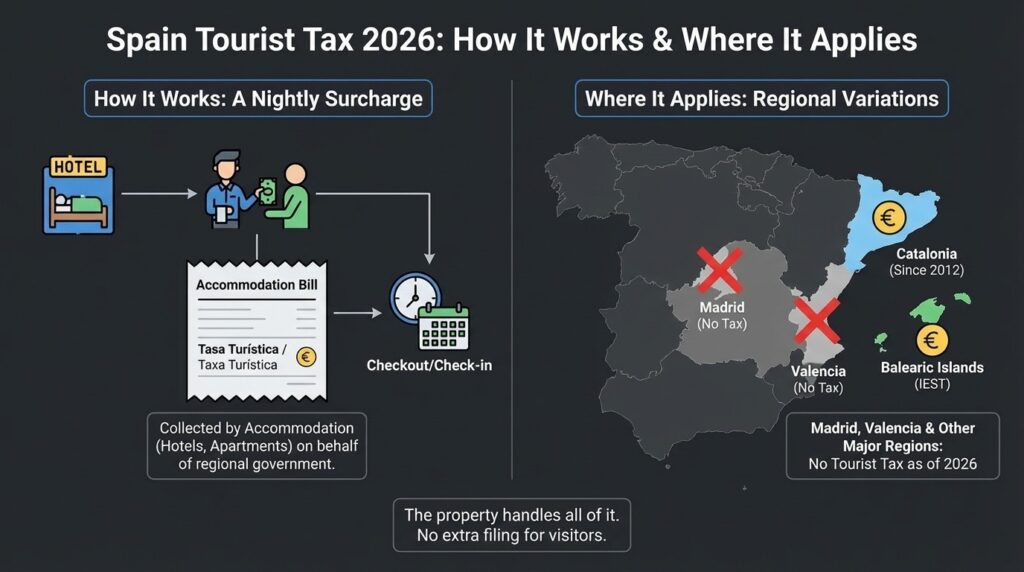
It’s a nightly accommodation surcharge. Nothing more dramatic than that. Your hotel or apartment host collects it on behalf of the regional government, and you’ll see it as a separate line item, “taxa turística” on your bill at check-in or checkout. You don’t file anything, you don’t visit any office. The property handles all of it.
Since 2012, this system has been present in Catalonia. Some islands, like the Balearic Islands, have their own variants of the IEST a few years later. Every other major region in Spain, including Madrid and Valencia, still doesn’t have one.
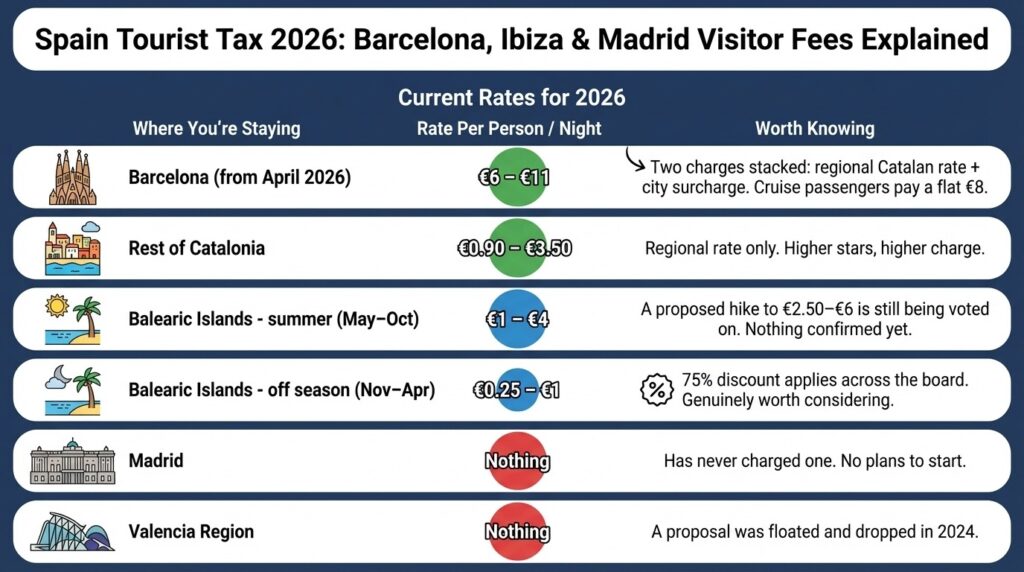
Current Rates for 2026
| Where You’re Staying | Rate Per Person / Night | Worth Knowing |
| Barcelona (from April 2026) | €6 – €11 | Two charges stacked: regional Catalan rate + city surcharge. Cruise passengers pay a flat €8. |
| Rest of Catalonia | €0.90 – €3.50 | Regional rate only. Higher stars, higher charge. |
| Balearic Islands – summer (May–Oct) | €1 – €4 | A proposed hike to €2.50–€6 is still being voted on. Nothing confirmed yet. |
| Balearic Islands – off season (Nov–Apr) | €0.25 – €1 | 75% discount applies across the board. Genuinely worth considering. |
| Madrid | Nothing | Has never charged one. No plans to start. |
| Valencia Region | Nothing | A proposal was floated and dropped in 2024. |
The Barcelona number is the one that genuinely catches people off guard. The Catalan parliament passed a rate increase effective 1 April 2026. The regional ceiling is now €4.50 per night, but the city then adds its own municipal layer on top. Combined, you’re looking at a minimum of €6 for a mid-range hotel and up to €11 for a five-star hotel. A couple doing five nights in the Eixample can easily rack up €60–€110 in tax before they’ve paid for a single meal.
Who Actually Has to Pay
Basically, everyone staying in a registered property is tourists, business travellers, and Spanish nationals visiting from another province. The logic the regional governments use is that if you’re sleeping there and using local infrastructure, you contribute to it. Fair enough, really.
Children under 16 are exempt in both Catalonia and the Balearic Islands. In the Balearics, guests with a recognised disability certificate of 33% or above also don’t pay. Those two exemptions are worth flagging if they apply to anyone in your group, because properties don’t always volunteer the information.
Long stays are capped. In Catalonia, once you’ve paid for seven consecutive nights at the same property, the charge stops; nights eight, nine, ten, and beyond are free of the tax. The Balearics offer a 50% discount from night nine onwards. Both caps reset the moment you change hotels.
Barcelona vs Madrid | Worth Talking About
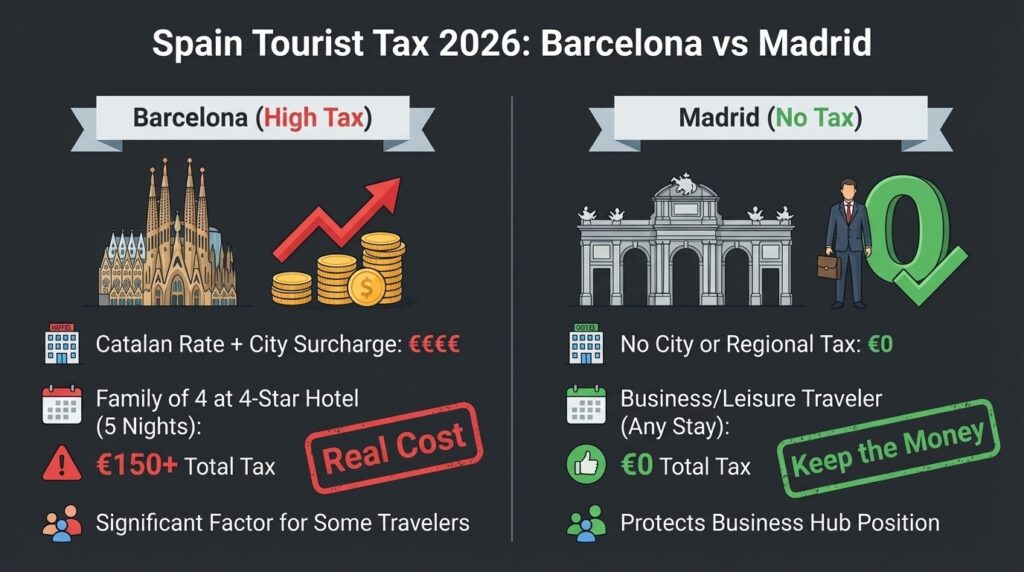
The difference is significant enough that it actually factors into destination decisions for some travellers. In Barcelona, you’re paying both the Catalan regional rate and a city-specific surcharge on top. A family of four at a four-star near the Sagrada Família, five nights, could be paying over €150 in tourist tax alone. That’s a real number.
The Madrid tourist tax 2026 situation is simple: there isn’t one. The regional government has consistently argued that an overnight levy would damage Madrid’s position as a business travel hub and push conference bookings toward other European capitals. Whether you agree with that reasoning or not, the outcome is the same: you keep the money.
How do you pay?
You don’t do anything complicated. The property collects it. Either they ask at check-in alongside your ID, or it appears on your checkout bill. If you pre-booked online, double-check whether the tax was included in what you already paid or whether it’s listed as payable locally – platforms handle this inconsistently, and it’s a common source of confusion.
Rural guesthouses in Catalonia sometimes ask for cash. City hotels take cards. Bringing a small float of euros is just sensible either way.
Quick Tips Before You Book
As the smart month Joyce, because technically still warm and significantly cheaper than the Ecotex and very small crowd relative to August, it would also be a great choice if you will stay in one place in Catalonia, because it will not RESET your 7-night cap. Moving properties resets the seven-night cap and costs you more in tax than it would have otherwise.
And if you’re still debating between Madrid and Barcelona as your main base, honestly, the tax difference is not the only reason to consider Madrid, but at these rates. It’s nothing either.
Common Questions
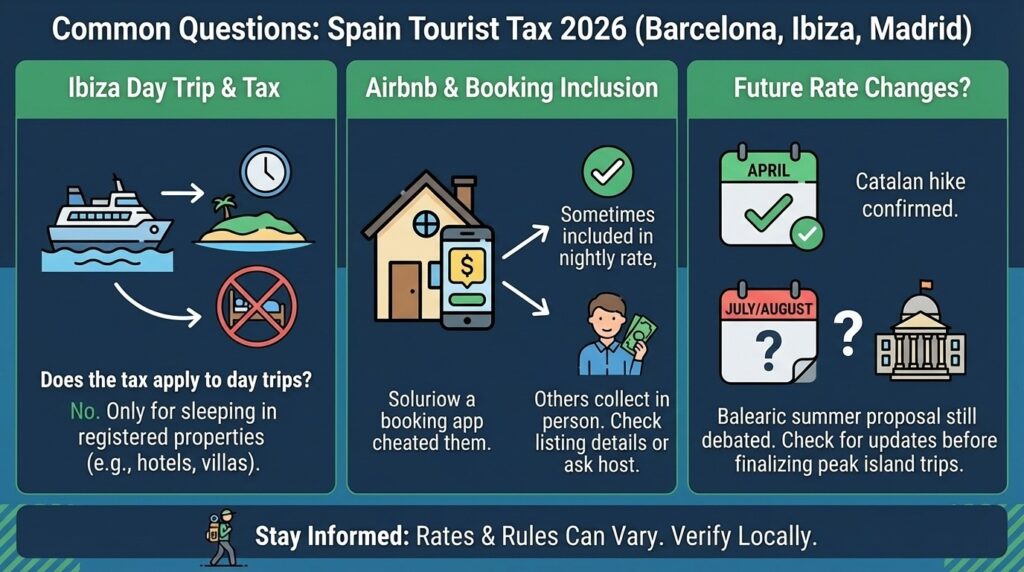
Q. Does the Ibiza tourist tax 2026 apply to a day trip from the mainland?
No, it only kicks in when you’re sleeping in a registered property.
Q. Will the tax already be included in my Airbnb booking price?
Sometimes. It varies by host and how their listing is configured. Some include it in the nightly rate, others collect in person. The listing description usually makes this clear – if it doesn’t, just ask before you arrive.
Q. Can rates change again before summer?
The April Catalan hike is done. The only live question is the Balearic summer proposal, which is still going through parliament. If you’re booking a July or August island trip, it’s worth checking back in a couple of months before you finalise anything.